
Vladyslav Pobyva
July 20, 2026
Vladyslav Pobyva
July 20, 2026

Have you ever received a push notification from the streaming platform you are subscribed to, recommending a show in a genre you are sure to enjoy? Or an email from the e-store you frequent, offering a discount on a T-shirt you secretly considered buying? We’re sure you have. And what was your reaction when this kind of personalized messaging reached you? “Hey, how can they know what I want?!” The answer is simple: they are really good at interpreting customer intent signals from user behavioral data.
This article defines what behavioral data is, describes its types and benefits, explains the nitty-gritty of behavioral data collection, outlines the ways to improve marketing results with behavioral data, and showcases how major-league brands with a powerful digital footprint leverage customer behavioral data to reach out to their current clientele, re-engage inactive customers, and increase app revenue.
Your clients, both potential and actual, take various actions when engaging with your brand across multiple customer touchpoints (both virtual and physical). Useful information about these customer interactions is known as behavioral data. These behavioral signals are a sort of breadcrumbs people leave behind, which are then picked up by companies via user activity tracking routines to learn about each customer’s characteristics, tastes, and habits. The data is also supremely useful for customer journey optimization, user flow analysis, and launching personalized marketing campaigns.
According to the source of the behavioral data, it is classified into three types.
Let’s dig deeper into various behavioral data examples.
The most common behavioral data examples are:

No matter what kind of data you track, behavioral data analysis ushers in numerous perks.
When accurately collected, thoroughly examined, and properly interpreted, behavioral data will grant you the following benefits.
Action-based insights not only describe what your users do but also explain why they behave this way. This information helps brands understand their clientele better and plan their marketing strategy accordingly by optimizing offerings, improving website navigation, fine-tuning campaigns, allocating resources, forecasting future trends, and delivering relevant customer experiences.
With behavioral data, you can rely not only on demographic attributes of the audience but also on behavior-based segmentation. For example, you can align your marketing initiatives with each client's customer lifecycle and implement real-time personalization, tailoring your approach to address the interests and pain points of each individual user.
Behavioral data is a key to turning a flat, static customer profile into a multi-dimensional, dynamic one. An in-depth profile is an excellent source of information for predicting customer intent, preventing churn, enhancing conversion, reducing marketing costs, and performing data-driven product development.
Analyzing each customer's spending patterns, purchase frequency, and engagement levels allows marketers to single out individuals who bring more value than others. Then, you can channel marketing efforts toward nurturing clients who deliver greater value, thereby maximizing ROI.
Behavioral data is the staple of customer retention in any lifecycle marketing strategy. It enables businesses to optimize onboarding, remove pitfalls and bottlenecks in the customer journey, anticipate client needs, and prevent churn, improving the overall customer lifetime value (CLV).
By analyzing clicks, scroll depths, session replays, and other behavioral data, experts identify and eliminate friction points, making the conversion funnel smoother.
To make the most of your customers’ behavioral data, you need to know where and how to get it.
The algorithm for garnering behavioral data varies depending on its source.
A website’s quantitative metrics can be obtained from Google Analytics 4 and Google Tag Manager. These tools allow you to track sessions, pageviews, events, and conversions through your website and make tag management a breeze. The best source of qualitative data on a website is short pop-up surveys encouraging users to leave feedback.
Getting behavioral data from an app is not that straightforward. First, you must select a third-party analytics solution that matches the app’s platform (web, Android, or iOS). Then, install the solution's Software Development Kit (SDK) into the app's codebase, adding project API keys to securely transmit data to the analytics dashboard. Once that is done, you must define the behaviors (sign-ups, session duration, feature usage, you name it) you want to track. Finally, inject tracking snippets into the application's frontend logic to enable data sending each time an action is spotted.
Typically, a marketing tech stack comprises multiple platforms. Make sure you implement event tracking through SDKs or embedded code snippets (tracking tags) across all of them. To get a complete picture from omnichannel behavioral data, you should pool it in a centralized hub. As a rule, companies do it by setting up customer data platforms (CDPs) or sending information to data warehouses (DWHs).
Most social networks come equipped with a feature that captures and presents behavioral data (such as LinkedIn Analytics or Meta Business Suite) and/or built-in polls (Instagram and X have these). Alternatively, there are various third-party tools you can use (like Brandwatch, Sprinklr, or Hootsuite) to monitor audience sentiment.
Surveys are also of great value for registering self-reported actions and attitudes. Businesses can send them via email or embed them in their app or website using specialized tools (Typeform and Qualtrics reign supreme among such solutions).
It's not only about NLP-powered interpretation of customers' verbal communications with your support team. The way they do it is equally vital. So, you should analyze the support channel they select, employ visual tools to see where users struggle when seeking help, map out their navigation paths, and track KPIs related to behavioral data (first-contact resolution, time to resolution, self-service abandonment rate, etc.).
Collecting all the behavioral data you can reach won’t take your marketing efforts far until you learn to use it.
Here are the most effective uses for behavioral data.
The correct interpretation of behavioral data helps development teams detect users' friction points, gauge feature adoption, simplify workflows, and validate changes via A/B testing.
By analyzing behavioral data, businesses design better website layouts, improve the text they contain, and make their real-time messages more effective. The same is true for offers, which can also be tweaked to become more relevant. Approaching clients with upselling and cross-selling initiatives at the right moment can make a world of difference.
Having a 360-degree view of their clients’ purchase behavior, desired benefits, and customer journey, marketers can divide the audience into granular groups and use these insights in event-triggered campaigns and lifecycle management strategies.
As app marketing insights indicate, personalization is the bedrock of successful digital marketing. Behavioral data allows companies to predict customer needs, adjust content and messaging, set up action-based triggers, and issue real-time recommendations.
Understanding what users feel allows organizations to spot signs of frustration (like rage clicks or closed pages), forecast intent, forestall churn, and allocate resources to features their customers actually care about.
Based on customer actions, marketers set messaging rules to unleash perfectly timed, relevant interventions that drive conversions and enhance engagement.
Let's see how business juggernauts use the customer behavioral data they collect.
The system utilized by this streaming service analyzes users' watch history, their devices and locations, timing, search queries, genres, instances of fast-forwarding/rewinding, show abandonment, and other behavioral data points. Then, customers with similar behavioral patterns are grouped to streamline the recommendation routine. Moreover, the viewers' tastes are used to show them the most effective thumbnails and posters, as well as to inform users about the rationale behind content recommendations ("because you watched…").

Point-of-sale data (purchases, returns, fitting room information, abandoned items) captured by the company’s software, AI-processed browsing habits registered by the official website, and social media engagement are examined to understand clients' sentiment and expectations. The conclusions the brand arrives at are considered when producing new items and designs in small batches rather than large seasonal collections. Customer reactions to these products are then scrutinized again to determine whether manufacturing should be scaled up. If the reception is lukewarm, the item is discontinued. This way, the organization avoids overstocking and saves a pretty penny by discontinuing the products that are unlikely to be purchased.
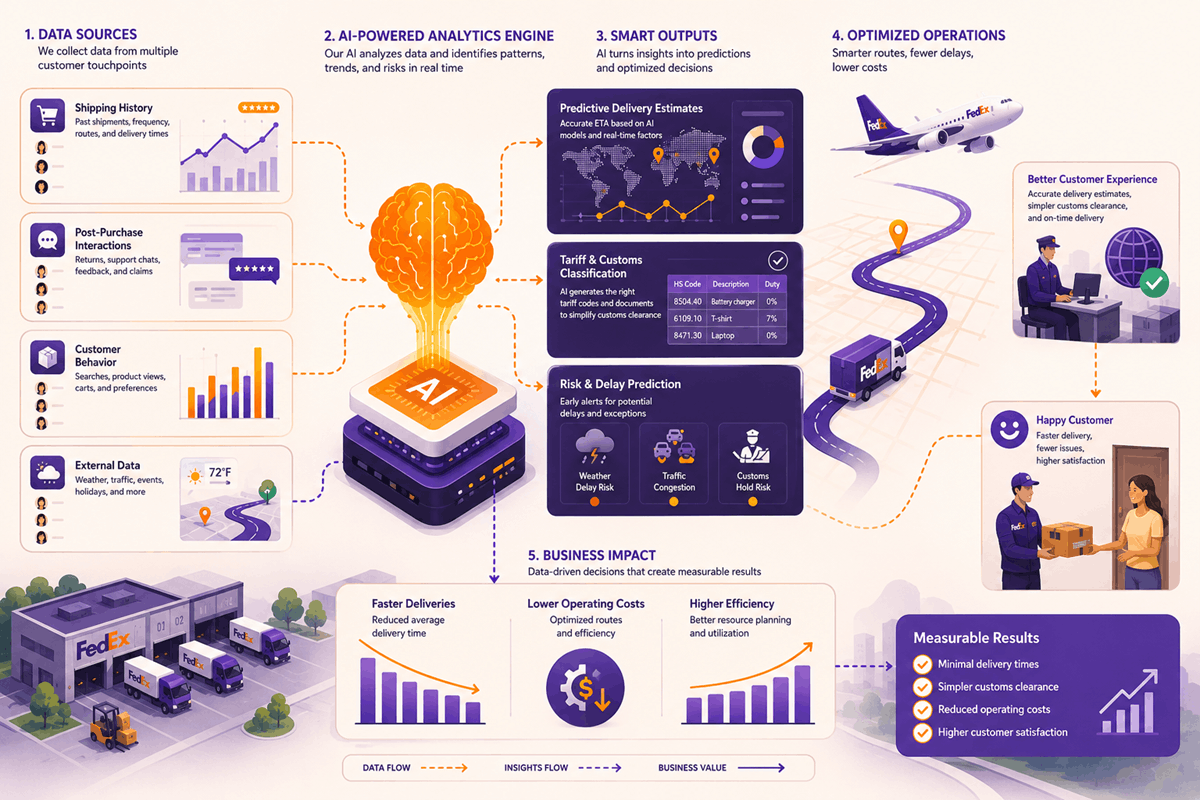
The AI-fueled supply management mechanism employed by this company has allowed it to shift from reactive package tracking to a proactive business model. By analyzing customer shipping behavior, post-purchase interactions, FedEx creates predictive delivery estimates and generates tariff schedule codes. As a result, FedEx’s customers enjoy simpler customs clearance and minimal delivery times, while the organization’s operating costs are dramatically reduced.
The company’s Release Radar and Discover Weekly predictive experiences rely on both implicit and explicit user behavioral data, including playlists, session lengths, replays, saved tracks, skips, and more. Besides, Spotify’s AI-driven engine evaluates multiple audio characteristics a song has (tempo, danceability, acousticness, etc.), while NLP mechanisms analyze lyrics. Taken together, these insights help find and recommend new compositions the user might like
No blue-chip brand would be able to leverage behavioral data so successfully without the robust software required for the task.
Reteno is an all-in-one, AI-driven messaging SaaS suite designed specifically for mobile-first businesses and honed to boost retention across all stages of the customer journey. The platform is an excellent tool for:
Turn your customers’ behavioral data into up to 15% of total app revenue through email and push notifications with Reteno.

Behavioral data is information about customer interactions (such as website and e-store actions, app usage, social media communications, email metrics, customer service contacts, and more) that is collected by businesses directly from clients, shared by their partners, or purchased from external agencies. When properly utilized, it can be highly instrumental for data-driven decision-making, deeper audience segmentation, improved targeting, customer retention, and conversions. You can make the most of behavioral data only if you employ high-end tools to handle it.
(1).png)
(1).png)
.png)

Alex Danchenko
|
November 8, 2023
Learn about data-driven marketing and how it revolutionizes marketing strategies with precise, personalized insights

Myroslav Protsan
|
June 16, 2026
Discover how real-time behavioral insights and AI-driven analytics enable retention marketers to predict churn, personalize customer experiences, and optimize LTV

Are your pushes as compelling as they could be? Find out with our free preview tool. Instantly see how your notifications will display on iOS and Android, in both expanded and collapsed views.
This is your chance to fine-tune your messages to ensure they're not just seen but felt. Make every character and every push work harder for your engagement goals


