Product Roadmap

Vladyslav Pobyva
March 27, 2026
March 27, 2026
A product roadmap is what stops a product team from running in five directions like a dog in a park. Someone wants a new feature. Someone else wants a full redesign. Sales is chasing a promise made three months ago. Marketing has a launch email half-written and nowhere to send it. The roadmap is what cuts through that — it tells everyone what the team is actually working toward, and just as importantly, what is not happening yet.
A product roadmap is the team's best current answer to one question: what actually matters next, and why? It connects the product strategy to daily decisions — which problems get attention, which user frustrations get fixed first, and what good looks like when the work lands.
In theory, that sounds manageable. In practice, it is often what stops a team from fixing things at random. Picture an ecommerce app where users browse, load up a cart, and then vanish before paying. Cart abandonment sits around 70% across the industry, which is less a mystery and more a signal that something in the path is broken. The roadmap is what forces the team to pick a lane: is it guest checkout, saved payment details, delivery clarity, or plain speed?
So what is a product roadmap, stripped down? It is the shared version of “what we believe matters now.” Not a warehouse of wishes. Not a graveyard of feature requests. Not a pretty slide someone shows once and forgets. A useful product roadmap tells teams what they are betting on and why that bet deserves time, money, and attention.
It should also make sense from the customer’s side of the screen. Customers do not care that a team completed Initiative 2.3 in Q3. They care that the app stopped lagging, checkout no longer feels like tax season, or recommendations suddenly became helpful instead of weird. That is why the roadmap has to reflect how customers actually experience the product — not how the team imagines it lands. When rivals feel quicker, cleaner, or more useful, the roadmap needs to address that directly rather than paper over it.
A product roadmap works by turning a broad product vision into something teams can actually act on without pretending the future is perfectly predictable. Usually, it starts with a few hard truths. Where is the product leaking value? What is frustrating customers? Which growth goal matters most this quarter? Which growth goal is worth chasing this quarter — and which requests are just dressed-up urgency with no real case behind them? Which initiatives genuinely serve the go-to-market strategy, and which ones are just urgency in disguise?
From there, the roadmap groups work into themes, outcomes, or considered bets. A subscription app might build its roadmap around onboarding, retention, pricing experiments, and referral loops. A retail brand might zero in on search, checkout, loyalty mechanics, and mobile speed.
That is also where cross-functional teams stop being a buzzword. Product, engineering, design, data, and marketing all look at the same work through different lenses. The product asks whether the idea supports the product strategy. Engineering asks whether the thing is realistic. Design asks whether it will feel intuitive. Marketing asks whether it can be explained without ten footnotes and a rescue dog. A roadmap is what keeps those perspectives pointed in the same direction instead of pulling apart into five separate plans that nobody admits contradict each other.
In agile development, the roadmap lives above the daily churn. It is not a sprint plan. It is not the backlog, which is where individual tasks stack up waiting for attention. The product roadmap sits above both. It explains the logic of movement.
A product roadmap matters because products rarely fail from a lack of ideas. They fail from scattered energy, fuzzy priorities, and teams building things that sounded clever in a meeting but did not fix anything in the real world.
Take mobile commerce. Google has reported that 53% of mobile visits are abandoned when a page takes longer than three seconds to load. One slow screen can quietly undo weeks of acquisition work — which is exactly why a roadmap has to be a live document, not something filed and forgotten.
That same logic protects teams from reactive planning. Without a product roadmap, every new request suddenly looks urgent. The loudest voice wins. The biggest client gets special treatment. A competitor launches something flashy, and the whole room starts sweating. With a roadmap, teams can look at new requests and ask a less emotional question: Does this fit the plan, or is it just noise wearing a nice jacket?
There is also the customer experience angle. PwC has found that a meaningful share of customers walk away after poor experiences, and even one bad interaction can do real damage. That makes stakeholder alignment more than a management cliché. It means the product team, support team, and growth team cannot afford to pull in opposite directions while the customer stands in the middle, getting annoyed.
The strongest product roadmap starts with outcomes, not a bag of product features. “Build a loyalty dashboard” is a task. “Increase repeat purchases from first-time buyers” is a goal. One is a line item. The other is a reason.
A roadmap should tie features to things that actually move: retention, conversion rate, average order value, activation, or churn reduction. If there is no plausible line between a feature and a real result, that feature probably belongs in a maybe pile, not on the plan.
Themes make a product roadmap readable. Instead of listing 27 unrelated tasks, group work under labels people can instantly understand: onboarding, trust, personalisation, subscription growth, search quality, or checkout simplicity.
Think of Duolingo. Its public product choices often feel like they serve a few clear themes at once: habit formation, engagement, and monetisation. Even if users only notice the streaks, reminders, or gamified progress, those choices do not feel random. That is the whole idea — a roadmap should read like a coherent argument, not a list of things people asked for over the past year.
Milestones are what give the product roadmap structure beyond good intentions. They might be a beta launch, a market test, an internal handoff, or a full release. They help teams avoid the vague swamp of “we’re working on it.”
Practical tip: not every milestone needs a dramatic launch date. The most useful milestones are often unglamorous: "tested with 50 real users" or "payment failure rate down by half." Those tend to matter more in practice than a polished launch announcement.
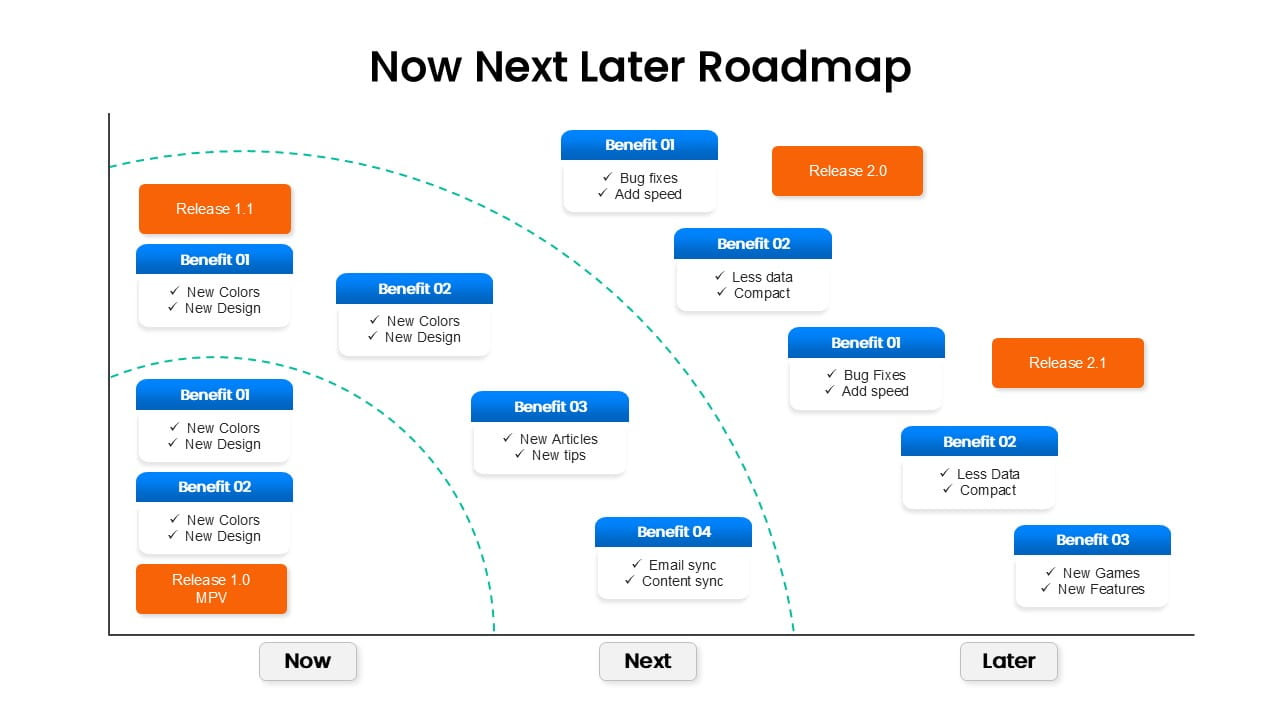
Roadmaps need time horizons, but honest ones. Attaching precise dates to work that is six months away is a good way to spend those six months managing expectations rather than building things. A now-next-later structure is often more honest, especially for products moving quickly.
Spotify-style thinking works well here. Users do not need a calendar promise for every experiment. Teams need enough structure to focus now, enough flexibility to adjust later.
A product roadmap should show movement. Planned, in progress, validating, launched, paused – these simple signals help everyone breathe easier. This is where roadmap software can help, but software is not magic dust. If the roadmap is confused, the tool will just make the confusion look more expensive.
A roadmap should name what it actually depends on — whether that is engineering headcount, a legal sign-off, a data pipeline that is not ready yet, or a market assumption that may not hold. Surfacing those things early is far less costly than discovering them mid-sprint.
A feature-based product roadmap is the classic format. It maps out what is planned and roughly when. This works well in B2B software, where customers are often waiting on something specific — an integration, a permissions model, a reporting view — before they can commit fully to the product.
The trap is that a feature roadmap can quietly become a place to park requests that nobody had the nerve to decline. It needs discipline and strong prioritisation.
%20(1).jpg)
An outcome-based roadmap measures itself against results, not releases. Instead of a redesign on the calendar, it might have "cut time-to-first-action in half" or "push subscription renewal above 80%." This style is usually healthier because it leaves room to learn.
For instance, Netflix does not win because it adds buttons for the sake of it. It wins when discovery feels easier, recommendations feel smarter, and playback friction stays low. The user notices the experience, not the internal ticket.
.jpg)
An agile roadmap is designed for products that expect the ground to shift. It keeps the team oriented without forcing them to honour assumptions that data may have already made obsolete.
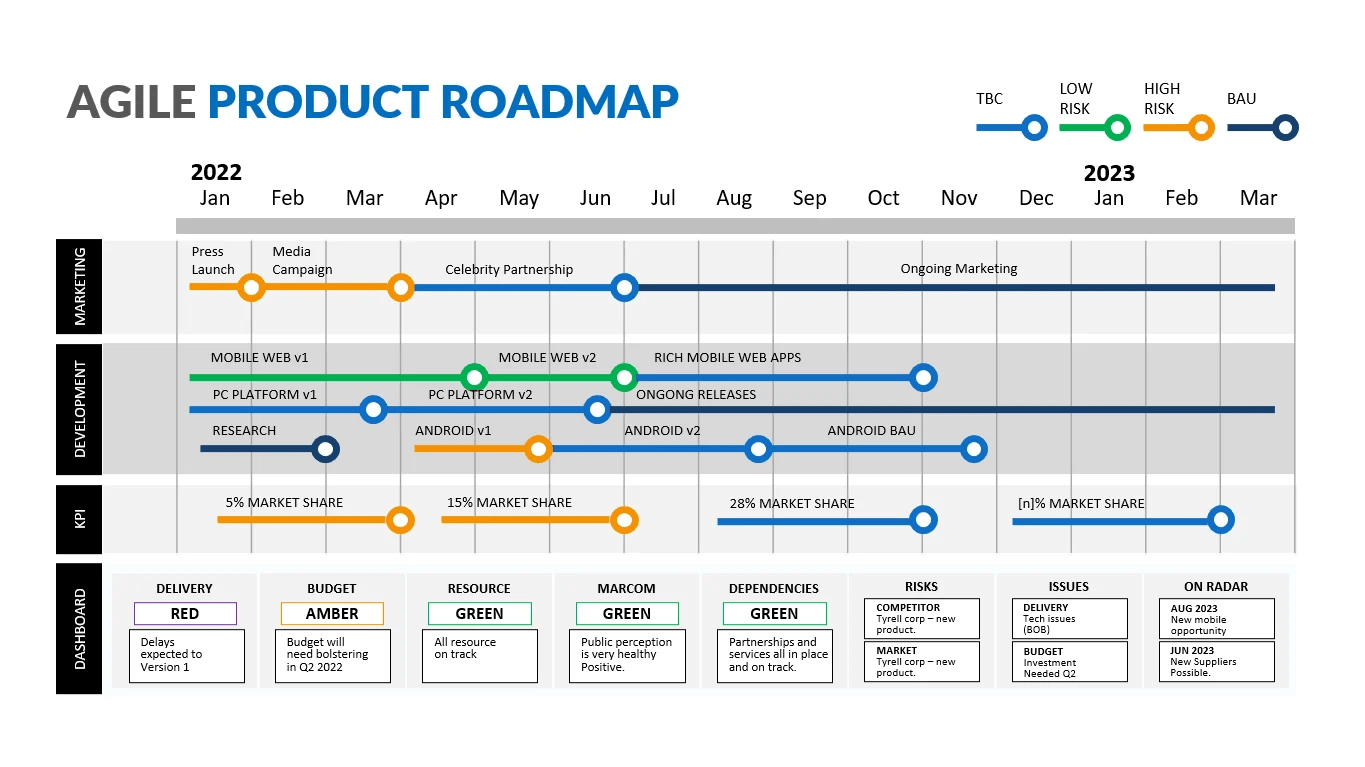
This type of product roadmap is popular because it is simple and human. People understand it immediately. What is happening now, what is likely next, and what lies later if the evidence still supports it. No fake precision. No theatre.
A visual product roadmap works best when teams need quick alignment. One strong product roadmap example can do more in a meeting than ten paragraphs of explanation. A board, a timeline, or a theme-based diagram helps people see priorities at a glance.
.jpg)
Start with the problem worth solving, not the solution someone has already grown attached to. Is the goal to fix early drop-off, grow repeat purchases, sharpen mobile app growth, or stop losing users somewhere in the post-acquisition digital marketing funnel?
Good roadmaps run on evidence: actual usage patterns, customer conversations, support queues, objections the sales team hears repeatedly, and direct feedback that does not get filtered before it arrives. McKinsey has reported that effective personalisation can lift revenues by 5% to 15% and improve marketing ROI by 10% to 30%. If customers are not finding what they need, that belongs in the plan — not sitting ignored in a spreadsheet.
This is the part where hard choices happen. Teams need to weigh initiatives against each other — looking at likely impact, the effort required, how urgent the need actually is, and whether the work fits the broader product vision.
Once priorities are clear, shape them into a readable high-level plan. Use themes, outcomes, or product areas. Then place them across a realistic timeframe.
Bring the draft to the people who will build it, explain it, and field the questions when something goes sideways. Roadmaps tend to unravel quietly — a leadership sign-off that glossed over real doubts, an engineering team that had concerns nobody asked about, a marketing team briefed too late to do anything useful with the information.
A roadmap should be visible, used, and revised. A stale roadmap template abandoned in Notion or Slides is not a roadmap. It is office wallpaper.
A smart ecommerce product roadmap often looks boring in the best possible way. It sweats the details that move money: speed, trust, search, delivery clarity, and checkout simplicity. Amazon's reputation in ecommerce was built largely on making friction disappear — checkout steps, delivery uncertainty, search noise. The mechanic becomes invisible when it works. That is often what the best roadmap work looks like once it ships.
For apps, a strong product roadmap often supports behaviour, not just functionality. Streaks, reminders, progress loops, and lightweight rewards are not random decorations. They are product choices aimed at repeated use. That is practical roadmapping tied to real behaviour.
For platforms, the product roadmap should not only chase core feature depth. It should consider how integrations, APIs, merchants, partners, and internal teams all fit together. That is where product management gets real.
The most common mistake is turning the product roadmap into a polite storage room for every request nobody wanted to reject. That roadmap becomes swollen, vague, and a little tragic.
Shipping more is not the same as moving forward. A roadmap that tracks launches but ignores whether anyone actually uses the thing — or whether it affected revenue at all — is measuring the wrong thing.
A roadmap should not shift with every new opinion, but it should adjust when the evidence calls for it. Holding rigidly to a plan in a market that has already moved is not discipline — it is just expensive stubbornness.
A product roadmap does its best work when it functions as an actual decision tool rather than a slide deck someone presents once a quarter to make strategy look tidy. For ecommerce and digital products, that matters because customers do not grade your internal effort – they react to speed, clarity, relevance, and ease. A sharp product roadmap helps teams spend less time chasing shiny objects and more time fixing the things customers actually notice.


(1).jpg)