
Alex Anikienko
Expert Writer
December 23, 2025
Alex Anikienko
Expert Writer
December 23, 2025

January typically offers a remarkable seasonal boost for health and fitness brands, as both downloads and in-app activity spike sharply. But let’s be real, that excitement usually fades quickly.
In our Q5 guide, we explored how health & fitness apps can convert the post-holiday surge of motivation into a wave of installs, trials, and early conversions.
However, Q5 is just the start. While January is when users arrive inspired, February and March determine whether they stay. Most apps lose a significant number of new subscribers within the first month, and many never return after one or two workouts or yoga sessions.
This article is your “Part 2.” Discover how to convert that Q5 spike into sustained Q1 subscription growth without spending all the world’s money, burning out users, or exhausting your team.
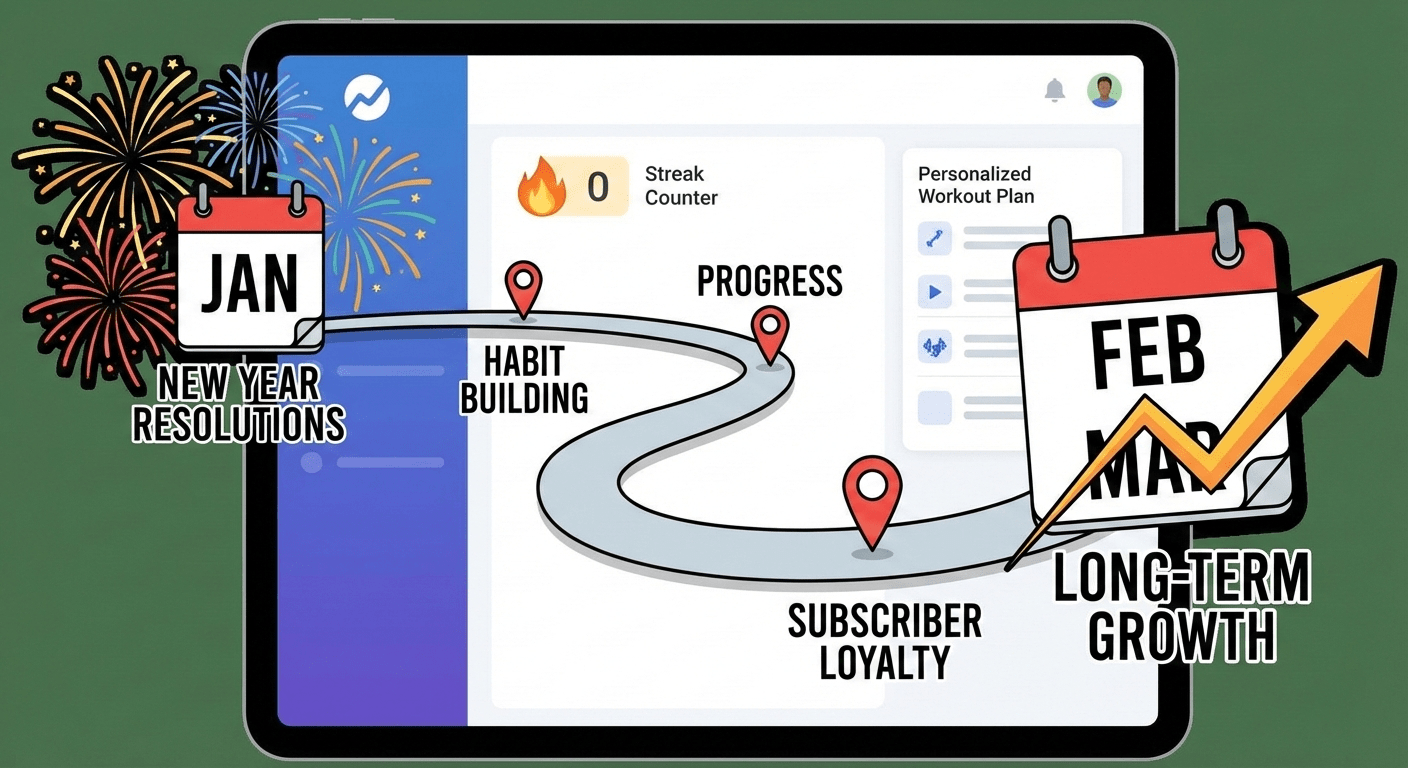
The short holiday period attracts highly motivated users who are ready to start a new life in the upcoming year. They’re eager to set goals, try new routines, and test premium features. But then reality sets in quickly:
This is why Q5 performance can be misleading unless you look ahead to Q1. A strong January does not guarantee a strong March. To retain these newly engaged users, a different approach is needed: one that shifts from hype about New Year’s resolutions to building sustainable habits.
Think of the next 90 days as three distinct product phases, not a single onboarding flow.
You’ve already done the hard work in Q5 by using resolution language and goal-based segmentation during sign-up to engage motivated subscribers. Now, your priority is to convert that initial motivation into immediate value.
Industry retention benchmarks show that Day 1 usability and perceived value greatly determine long-term retention. If users don’t perceive value quickly, they’re unlikely to stick around. On average, retention drops steeply in the first week across app categories, from around 26% on Day 1 to about 13% on Day 7.
Your goal for this phase: move health buffs from external motivation (“I should do this in January”) to internal experience (“I felt good doing this”), because users who experience value early on are far more likely to stay engaged.

While the first week focuses on spark, the rest of Month 1 is about stick. During this period, your job is to shape behavioral expectations and psychological rewards so that the app becomes part of users’ routines.
Why this matters: apps that explicitly develop habits by making routines feel familiar and rewarding typically see significantly better retention in Month 1, turning early customer curiosity into a weekly ritual.
By the start of Month 2, you’ve passed one of the toughest thresholds in mobile app engagement. Benchmarks indicate that many H&F apps have a retention rate of around 3-8% by Day 30. The next two months are a transition phase from habit to meaningful value and then to progressive monetization.
Monetization peaks when value becomes visible. While exact conversion figures vary widely, broader industry data proves that install-to-paid conversion rates in subscription-focused apps can range from about 18% to 38% without trials and flow directly from perceived value.
Within 45–90 days, users who have built a consistent habit and achieved tangible results are far more receptive to upgrading to premium plans, coaching add-ons, or extended content libraries. Free-to-paid conversion peaks when subscribers can feel the difference that your premium offering makes in their daily activities.
Even a small team can successfully execute a Q5-to-Q1 retention strategy with the right set of marketing automation solutions.
As a result, you’ll get a seamless transition from Q5 acquisition to Q1 loyalty with just enough manual effort.
While Q5 brings motivated prospects, Q1 decides whether they become loyal users.
If you treat January as an extension of the acquisition period, the resolution energy will fade quickly. However, when you shift your strategy from hype to habit-building and from generic blasts to behavioral journeys, you give subscribers a reason to stay.
The difference isn’t in sending more messages or having a bigger budget. It’s in better-timed, goal-oriented communication that helps workout enthusiasts build routines they don’t want to break.
Your Q5 success shouldn’t end in February. Let’s make it last. Convert seasonal spikes into long-term subscription revenue growth.
👉 Choose a Reteno plan to optimize your messaging strategy today, or
👉 Book a free personalized demo and explore how Reteno can maximize Q5-to-Q1 retention in your campaigns.
(1).png)
(1).png)
.png)

Natalya Ustymenko
|
June 1, 2023
Learn about the types of health and fitness apps and how to build an effective marketing strategy

George Johnson
|
November 24, 2025
Explore Meta’s latest insights on creative dynamics, true performance levers, and the role — plus limits — of AI in scaling fitness apps

Are your pushes as compelling as they could be? Find out with our free preview tool. Instantly see how your notifications will display on iOS and Android, in both expanded and collapsed views.
This is your chance to fine-tune your messages to ensure they're not just seen but felt. Make every character and every push work harder for your engagement goals


