
Vladyslav Pobyva
November 13, 2026
Vladyslav Pobyva
November 13, 2026

For any e-store, maximum eCommerce personalization is the ultimate goal and, at the same time, the centerpiece of its marketing and promotional strategies as well as customer journey orchestration. Brands go the extra mile to tailor shopping experiences to the tastes, preferences, and pain points of their clientele. The across-the-board advent of disruptive technologies is taking online companies’ efforts to the next level by employing artificial intelligence and machine learning models to deliver omnichannel personalization across all aspects of brand-customer interaction.
Read on to discover the definition of AI personalization in eCommerce, unlock its mechanics, types, benefits, and use cases; see personalization examples of big-time businesses that rely on artificial intelligence for behavioral user segmentation and real-time personalization; and learn recommendations for implementing AI personalization on your e-store.
Traditionally, marketers have relied on classic customer segmentation, based on dividing the clientele into static groups based on demographics. It used to treat every member of the group identically and was slow to update. The rule-based approach, which uses if-then logic to launch trigger-based campaigns, has helped improve the relevance of mobile push notifications and personalized email campaigns. However, because the customer base and online catalogs have grown exponentially, and eCommerce has gone global, both mechanisms fail to help companies home in on each consumer individually. This is where cutting-edge know-how comes in.
AI personalization in eCommerce employs machine learning (ML) algorithms and natural language processing (NLP) to collect and sift through vast amounts of customer-related information (mostly relying on first-party data) and behavioral intent signals. Then, the results are used in predictive segmentation and analytics to anticipate each customer’s desires and actions, and offer what they want, here and now.
At first, unified customer profiles for each client are created in the customer data platform (CDP). They are filled with clickstream data of various kinds, including behavioral (page views, clicks, time spent, browse abandonments, etc.), transactional (purchase history, order frequency, and average order value (AOV)), preference (saved items and wishlists), and contextual (device type, time of day, location, etc.) information.
At the second stage of AI personalization in eCommerce, this enormous bulk of data is analyzed by predictive ML models. Then, they tweak the eCommerce website or app to show a particular customer the next-best action or next-best offer. This tweaking and adjustment never stops, as real-time data streaming continues as new information about the client is injected into the system and analyzed. So, recommendation widgets modify their operation constantly by re-ranking product carousels, modifying dynamic content, or triggering personalized messaging and product recommendations across multiple touchpoints.
Propensity modeling, event-based automation, triggered messaging, and other AI-based techniques usher in significant improvements in basic KPIs eCommerce companies track to gauge the success of their AI personalization initiatives, namely:
These benchmarks in churn prediction and prevention, conversion rate optimization, and revenue growth are achieved by brands that use AI personalization in eCommerce.
The most popular types of AI personalization in the eCommerce industry are:
An AI-based product recommendation engine that relies on event-based and collaborative filtering to show site visitors “recommended for you” products and similar items on product pages and in checkout flows.
Keyword matches that served as the basis for showing search results before are replaced by semantic meaning and user intent that are extracted from queries by NLP-powered tools.
Shoppers upload an image to the website, and AI personalization algorithms work to find matching items in the product catalog.
LLM-driven chatbots and assistants are second-to-none tools companies employ for proactive product discovery and guided selling.
To sell their goods effectively, e-stores should know how to position them so every shopper sees what they came for at once. AI-driven merchandising is tailored to do just that. Smart AI personalization tools adjust hero images, collection pages, homepage banners, and other promotional content based on the viewer’s past purchase history, traffic source, and browsing behavior, meeting their expectations with what they want to see on the screen.
Promotional messages customers receive during their interaction with the brand (such as mobile or web push notifications, emails, or SMS) aren’t sent randomly. The shopper receives one of these when they do something meaningful on the site or app (abandon cart or browsing, post a search query, interact with out-of-stock items, etc.).
Universal pricing on online stores is quickly becoming extinct, because what works for one consumer segment is a forbidding sum for others. AI personalization agents assess competitor rates, demand fluctuations, inventory levels, and other parameters in real time and implement flexible pricing models to meet customers halfway on their budgets.
Also known as segment-of-one marketing, this technique is gaining ever-wider traction nowadays. AI-fueled software enables a super-granular approach to client segmentation and narrows its focus not on a group of shoppers with similar interests and needs, but on one individual consumer. It is possible by training recommendation algorithms to take into account contextual signals, zero-party data, and purchase-intent modeling, so they can home in on each shopper individually.
Each AI personalization use case in the eCommerce industry works only if the right tactic is used for each scenario.
Ideally, it is a two-way street. Shoppers describe the product they need, and AI agents ask clarifying questions. This lets its algorithms narrow the search and show only relevant results.
No more static cross-sells. ML models analyze whether the viewer is just browsing or displays signs of buying. When the latter is evident, prompts like "frequently bought together" are displayed to the customer.
One-size-fits-all hero banners, layout orders, and feature collections are growing obsolete at a breakneck speed. All website elements should differ for new vs. returning website visitors, while AI personalization tools align them with past viewing habits, preferred categories, and traffic sources.
These virtual advisers and helpers excel at handling complex inquiries, relying on context to recommend products, and providing round-the-clock customer support. How can they do it? State-of-the-art NLP technologies that power them are advanced enough to enable near-human communication between them and shoppers.
The primary use case of augmented reality in eCommerce is virtual try-ons offered by many e-stores today. However, AR’s application range expands rapidly as beauty brands find it handy for virtual skin analysis or makeup application recommendations.
As marketers admit, retaining current customers is much easier and cheaper than finding new ones. AI personalization acts as an effective customer retention technique by reading behavioral signals indicative of possible churn and reaching out to dormant clients to re-engage them. It can dynamically change content based on likely reasons for leaving or offer personalized discounts through the channels the person prefers.
Not only should website content and product recommendations be tailored to each customer, but prices and promotions should follow suit, too. They are adjusted in real time, localized, and bundled into discount categories by AI-powered algorithms that do their job by analyzing demand signals, competitor tracking, and projected CLV for each customer.
How do major-league companies capitalize on these AI eCommerce personalization techniques?
Global business giants stay in tune with their customers, thanks in part to personalization initiatives powered by cutting-edge tech.
This lifestyle brand featured on Shopify employs AI to place items that the viewer has looked at recently at the top of the feed, with the list updated in real time.

The company reports an 11+% increase in order rates resulting from this innovation, with its on-site campaigns generating 20% of online revenue.
This eCommerce behemoth relies on advanced AI personalization algorithms to conduct real-time analysis of a consumer’s purchase history and browsing behavior. Then, complementary products are shown to the shopper.
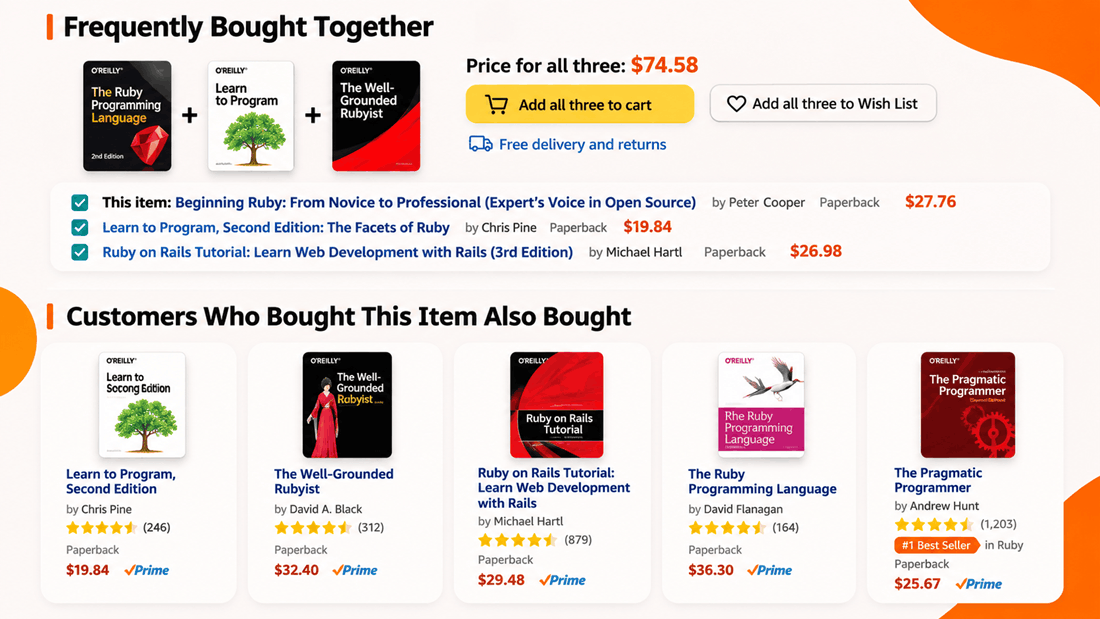
Such upselling and cross-selling mechanisms result in a win-win approach: customers quickly discover relevant goods, and the seller enjoys a larger basket size, which translates into higher revenue.
Universally recognized trailblazers in virtual try-ons are Gucci and Burberry. Seeing the success of this technique, other brands want to emulate it. Nubikk, as a premium online-first footwear brand, also integrates AI-powered AR sizing into web and app browsers. This helps clients better understand materials, proportions, and styling.
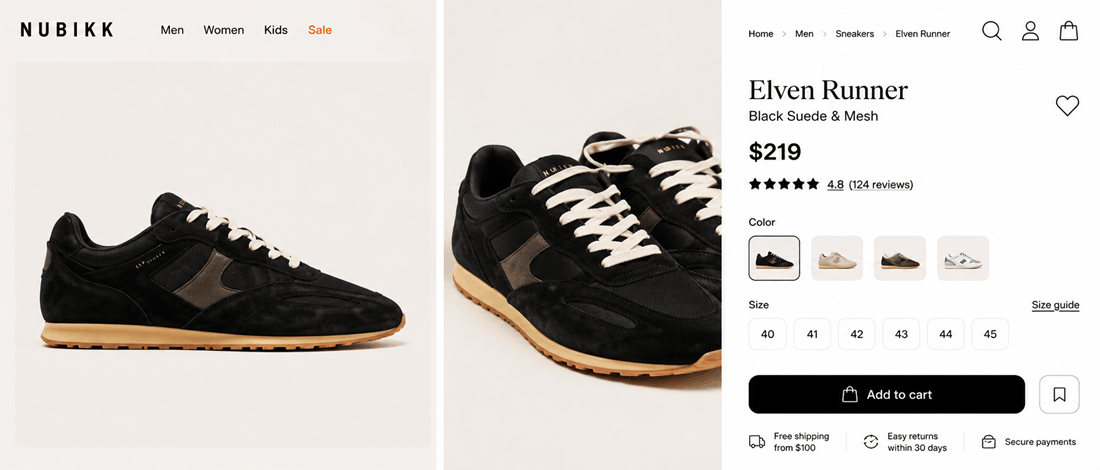
People enjoy this camera-based AR experience to inspect shoes in detail, rotate them, and choose the size they need directly from product pages. And how does the brand know what customers need? AI algorithms figure it out by analyzing answers to behavioral questions about the footwear the person has in their closet. The outcome is a 12% increase in CTRs on pages with the available AR experiences.
This luxury lingerie brand highlights recommendations while the viewer is browsing, matching them to what is on the screen and what the consumer might consider for purchase.
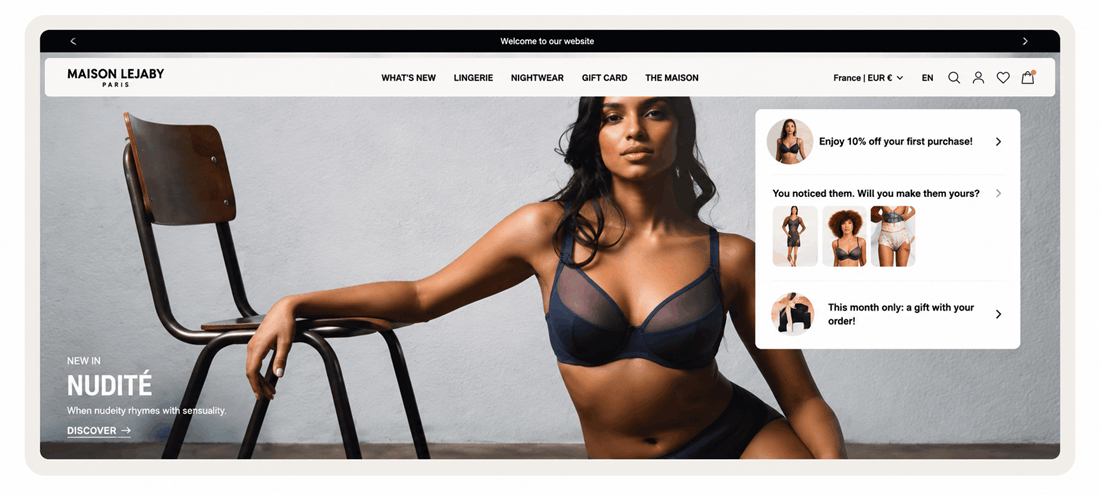
By using this AI-based on-site feed, the company managed to achieve a 15% CTR, which had a positive impact on sales.
Instead of displaying to returning customers a generic sign-up form that greets new site visitors, Dermatologica, a leading skincare brand, shows them a popup with products they viewed during their last visit. This move allows loyal clients to resume the browsing they interrupted before.

When this combination of CRM and AI personalization was introduced, it yielded a 5% CTR on the targeted popup and an almost 7% increase in AOV.
Sounds impressive, doesn't it? Well, if you want to follow suit, here's a roadmap for implementing AI eCommerce personalization.
Setting up AI personalization for your online store requires six simple steps.
“Improving lead generation" is not the right way to phrase your goal. Instead of stating the objective, specify the exact milestone you want to achieve, set the timeframe, choose the method you'll use, and define the metrics that will show the project's success. That is why your goal should sound like “increasing AOV by 10% within half a year via personalized search and merchandising.”
Data quality determines how favorable the outcome will be. Gather client-related information from all available channels and touchpoints, and collect it in one digital depot that will serve as the single source of truth for ML algorithms.
Look for an all-in-one AI-based platform that is honed for your specific goal and can help you create consistent shopping experiences across all channels without costly add-ons.
Start small. AI personalization in eCommerce should begin with a maximum of two (or preferably one) high-impact but simple scenario(s) (say, creating personalized landing pages or minimizing cart abandonment) and hold a comprehensive A/B test of it/them with clear success benchmarks.
Once the chosen method of AI personalization pans out and yields tangible results, move on to implementing other personalization scenarios (email campaigns, pricing, checkout process, upselling and cross-selling strategies, product layouts, you name it) along the same lines.
A common mistake among budding entrepreneurs is believing that what worked once will work forever. Never consider your eCommerce personalization strategy as something carved in stone. You should extend your methods beyond your seed audience, introduce lookalike modeling, try new tactics, and continuously fine-tune personalization techniques while paying close attention to user consent and data privacy standards.
Reteno is a first-rate messaging platform for subscription and mobile-first eCommerce that helps online businesses implement AI personalization at scale. The solution relies on NLP to create generative AI content in multiple variations and leverages AI for the always-on A/B testing of copy and for automating web and mobile push notifications, in-app messaging, email, and SMS. Moreover, Reteno provides a built-in AI assistant that lets marketers create and modify customer journeys (including post-purchase journeys) in the workflow editor. The platform is user-friendly because you don't need to know code to work with it. Even non-tech workers can issue commands in natural language and use the tool to segment contacts, edit templates, run campaigns, and pull analytics.
With Reteno, you can cover all your eCommerce personalization needs, from creating unified customer profiles and client segmentation to event-based automation and omnichannel delivery of relevant messages.
In the eCommerce sector, AI personalization involves leveraging ML- and NLP-powered solutions to know a company's customers inside out and tailor its messaging and marketing strategies to each individual's preferences and tastes. By using AI-fueled tools, eCommerce organizations improve core KPIs (conversion rate, retention index, average order value, abandoned cart recovery, search-to-purchase rate, customer lifetime value, and more). The AI personalization types that work well in eCommerce include smart product recommendations, personalized search, conversational assistants and visual search, dynamic pricing, promotions, and layouts, and hyper-personalization.
To implement AI-driven personalization for your e-store effectively, you should follow a clearly defined roadmap and use specialized software platforms.


Natalya Ustymenko
|
November 10, 2022
Find out what app personalization ideas you should implement to improve communication with your audience

Alex Anikienko
|
October 13, 2025
Learn how to replace risky third-party tracking with personalized strategies that protect privacy, reduce churn, and boost revenue

Are your pushes as compelling as they could be? Find out with our free preview tool. Instantly see how your notifications will display on iOS and Android, in both expanded and collapsed views.
This is your chance to fine-tune your messages to ensure they're not just seen but felt. Make every character and every push work harder for your engagement goals


