
Alex Anikienko
Expert Writer
December 16, 2025
Alex Anikienko
Expert Writer
December 16, 2025
.png)
On average, smartphone users receive over 40 push notifications per day. Yet, only 18% of these are typically considered valuable.
By 2025, apps had automated more communication than ever before. However, the extent of automation revealed a cold truth: messaging failed not because users hate notifications, but because automated alerts were impersonal, irrelevant, and poorly timed.
Reteno’s fatigue research repeatedly proved this, especially in fatigue-adjusted ROI models, showing how over-touching erodes lifetime value (LTV) faster than under-touching ever did.
This is why, this year, we stopped asking, “Did this campaign perform?” and started asking, “Did this message help or undermine engagement and retention efforts?”
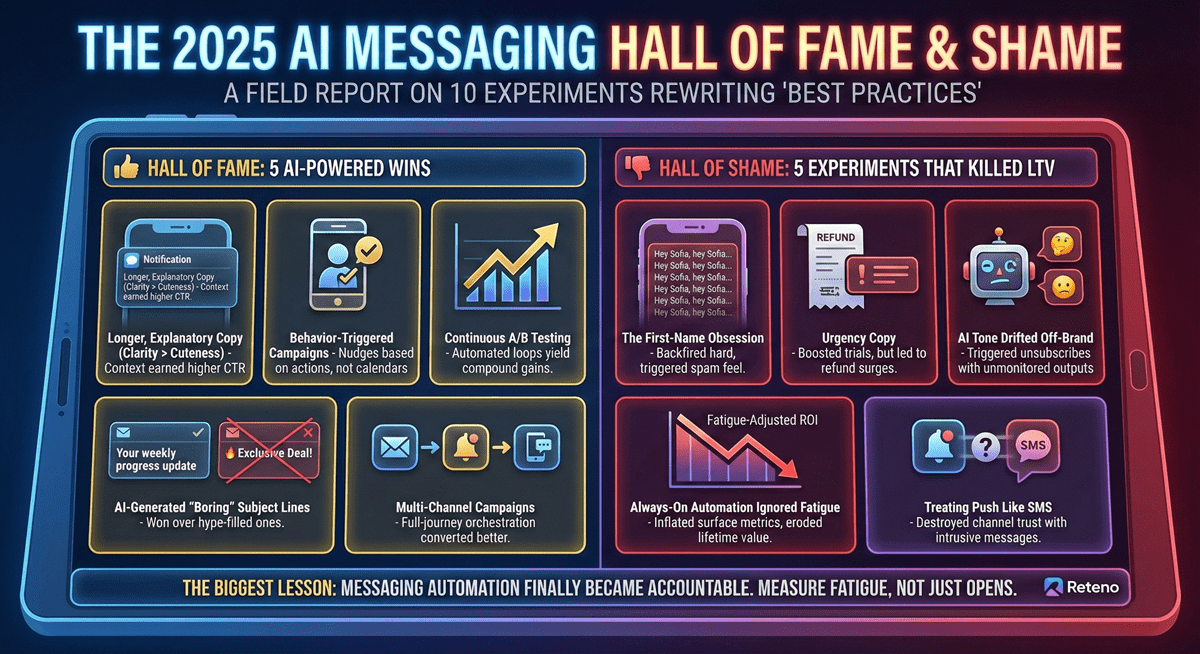
Welcome to the 2025 AI Messaging Hall of Fame & Shame, a field report on 10 experiments that redefined what “best practices” actually mean:
The biggest lesson of 2025 wasn’t that messaging automation became smarter.
It’s that messaging automation finally became accountable.
As in many fields, the best practices for automated messaging are not static. Rather, they are battle scars from continuous full-campaign experiments.
As part of a viable communication strategy, AI reinforces creativity and reveals how misguided most of our assumptions are about what users actually value.
For years, marketers believed:
2025 proved the opposite. The turning point came when brands finally started measuring fatigue instead of just opens and clicks. Performance without fatigue scoring turned out to be fool’s gold: campaigns that seemed successful today often fueled tomorrow’s churn.
This realization rewrote how success is defined in automated messaging.
For years, messaging guides emphasized brevity. However, in 2025, longer, AI-generated notifications with context and beneficial outcomes earned higher click-through rates (CTRs), validating Reteno’s advice in 7 Dos & Don'ts of AI Messaging: clarity typically outperforms cuteness.
Nudges based on user actions, such as completing a lesson, hitting a streak, or revisiting a paywall, earned more trust and engagement than generic “Monday Motivation!” alerts.
This mirrors Reteno’s philosophy outlined in Push Notification Best Practices for 2026.
Another sleeper success of 2025 was always-on experimentation.
Teams that used AI to continuously rotate and improve copy variants in real time saw compound gains in CTR, activation, and retention instead of conducting quarterly tests or one-off split runs.
This validated Reteno’s earlier insight from The Hidden ROI of Failed A/B Tests: most tests don’t “win,” but the learning process is what matters. In 2025, AI finally automated that loop, transforming experimentation from a project into a system.
One brand confidently expected the flashy “🔥 Exclusive Deal!” to outperform the straightforward “Your weekly progress update.” The reality was that users trusted the “boring” one more.
AI-generated subject lines that removed hype and delivered practical clarity boosted customer engagement and reduced unsubscribe rates. This reinforces Reteno’s tone guidance: if your copy sounds like a parody of marketing, users will tune out.
The winning campaign wasn’t blast-and-pray. Rather, it looked like this: email → push → in-app.
Why? It mirrored user habits, as detailed in our In-App Messaging Best Practices for 2025. Full-journey orchestration turns one-and-done into loyalty loops that move engaged users through intent stages without overloading them.
It’s time for the cringe compilation. The following moves seemed brilliant in theory but caused trust to erode and churn to spike in practice. We’ve anonymized them, but the patterns will resonate with anyone scaling AI copy.
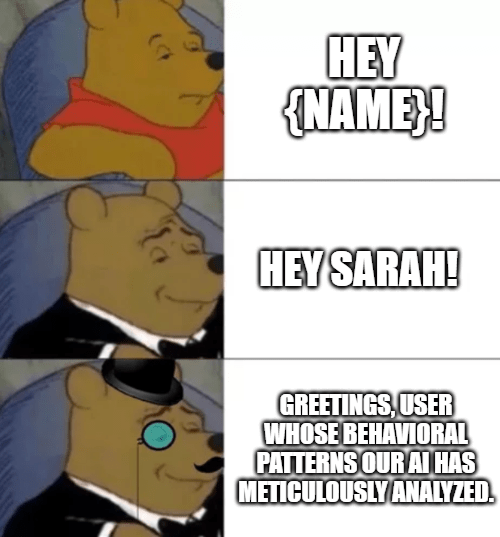
“Hey Sofia, hey Sofia, hey Sofia…”
Instead of fostering an intimate connection, brands triggered spam-alert creepiness. As our 5 Ways to Personalize without Violating Privacy warns, overkill cultivates skepticism. Reteno had already warned against this “personalization theater” in its guide: personalize with purpose, not excess.
Aggressive alerts such as “Upgrade or lose everything!” drove trial spikes, but later revealed something dark: refund surges and cancellation bitterness.
This is a textbook example of fatigue mismanagement, which Reteno cautions against in its analysis of Hidden ROI Erosion from Over-Messaging within your app. User churn is not a KPI we celebrate.
A brand turned AI loose without tone guardrails:
Instead of boosting subscriptions, unsubscribes increased — a result that Reteno experts did not find surprising.
Users felt that something was “off,” not because a robot wrote it, but because the brand didn’t proofread or constrain the inputs.
AI is a perfect tool. However, unmonitored outputs can be costly to your business.
Marketers loved bragging about their 50+ automation flows. However, users did not.
Rather than boosting customer engagement, apps kept firing “just one more alert,” which crashed their fatigue-adjusted ROI (FAROI). What appeared to be smart growth actually resulted in silent LTV erosion, driven by burnout, opt-outs, and users tuning out entirely.
The lesson is simple: when implementing a communication strategy, scale copy relevance, not the number of messaging flows.
Marketers blurred those roles when they sent long, text-heavy scripts as push notifications or rapid, nudge-like SMS messages. As a result, customer engagement collapsed. Users didn’t know what level of urgency or intent to expect anymore.
Each communication channel carries its own psychological weight. Mix them up, and subscribers will stop trusting both.
Let’s keep it simple.
1. AI isn’t the advantage. Experimentation maturity is. If your testing culture was disorganized before, AI won’t fix it. It will amplify the chaos. New technologies accelerate learning, but they also quickly reinforce wrong practices.
2. Guardrail metrics matter more than surface metrics. CTR, open rates, and trial starts? Nice. But none of them warn you when refunds spike, user churn swells, or trust erodes.
The real signals lie in fatigue-aware metrics, unsubscribe sensitivity, and regret windows. They tell you what actually generates revenue.
3. AI messaging standards are now strategic infrastructure. The teams that won 2025 didn’t just “use AI.” They built guardrails around it:
If these principles sound familiar, it’s because they run through every major Reteno playbook.
2025 debunked the myth that boldness drives engagement.
2026 will reward teams that turn insights into systems and systems into predictable revenue.
Are you ready to implement everything you just read, including continuous A/B testing, fatigue-adjusted campaigns, AI copy guardrails, and multi-channel orchestration? Reteno is here to make it all happen.
👉 Choose a Reteno plan that fits your growth goals.
👉 Or book a personalized demo to see these capabilities in action.
Your 2026 messaging strategy won’t build itself. Reteno can build it with you.
(1).png)
(1).png)
.png)

Myroslav Protsan
|
September 8, 2023
Learn the importance of in-app messages for mobile app success, explore message types for effective campaigns

George Johnson
|
November 26, 2025
Discover the key reasons your text messages don’t get delivered — and how to resolve them quickly

Are your pushes as compelling as they could be? Find out with our free preview tool. Instantly see how your notifications will display on iOS and Android, in both expanded and collapsed views.
This is your chance to fine-tune your messages to ensure they're not just seen but felt. Make every character and every push work harder for your engagement goals


